When parents first hear the phrase Montessori discipline, many imagine a free-for-all environment where children set all the rules.
There is just one problem with that.
That version of discipline is permissive parenting, and it is the opposite of what Montessori discipline is about.
If you are struggling with tantrums, power struggles, or constant reminders, you are probably feeling exhausted and discouraged.
That is completely understandable! Parenting without a framework can feel chaotic.
The good news is that Montessori discipline is one of the most structured and respectful approaches to raising confident and capable children. It gives you a clear framework for holding firm limits while staying calm, connected, and consistent. This framework comes directly from Positive Discipline, the approach created by Jane Nelsen, which is the same method we use to train all Guidepost Montessori teachers.
At its core, Montessori discipline is built on mutual respect, natural consequences, and skill building instead of punishments or bribes. It helps children learn how to regulate themselves, not just how to behave when an adult is watching.
Below is our practical, parent-friendly guide to understanding Montessori discipline and using it in everyday life.
What Is Montessori Discipline?
To be completely honest, “Montessori discipline” is not a traditional discipline method. It is more of a googled phrase that brings families to the right idea.
And that is exactly why we wrote this guide! We want you to have the real facts behind the scenes.
Most parents searching for “Montessori discipline” are actually looking for more calm, more structure, and more cooperation at home. The good news is that the Positive Discipline framework we use in our classrooms translates beautifully into home life.
To that end, “Montessori discipline,” also known as Positive Discipline, is a guidance approach that helps children develop self control, problem solving skills, and respect for themselves and others.
Instead of rewarding “good” behavior or punishing “bad” behavior, Positive Discipline focuses on teaching the skills behind the behavior. Children learn through modeling, connection, and consistent routines.
Over time, this builds internal motivation rather than dependence on external pressure or rewards.
When people refer to Montessori discipline, they are almost always describing the authoritative parenting style in the Baumrind framework. This style combines high warmth with high responsibility.
Here is what that looks like at home:
- Parents are kind and firm at the same time.
- Children feel emotionally safe.
- Children experience clear limits and consistent follow through.
- Expectations are predictable and fair.
- Adults guide instead of controlling or criticizing.
This balance helps children cooperate because they trust the adult and understand what is expected of them.
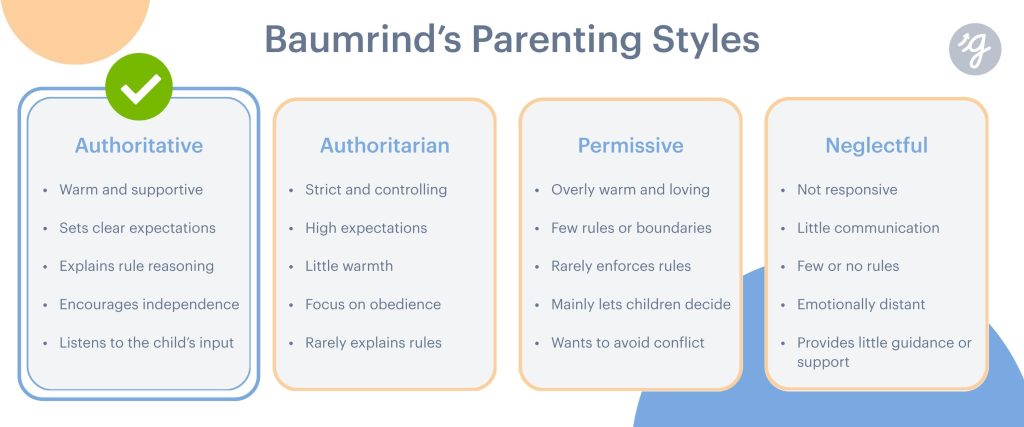
Baumrind’s authoritative parenting style help us understand how warmth and expectations shape development. It is the exact foundation of Positive Discipline.
Why Positive Discipline Works
Positive discipline works because it meets the real needs of your child’s developing brain. It focuses on teaching skills, guiding behavior, and strengthening the parent-child relationship, which is the foundation for cooperation and healthy development.
1. It teaches, rather than punishes
Punishment may stop a behavior for the moment, but it does not teach the child what to do next time. In many cases, punishment creates shame, fear, or resentment, which blocks learning and damages connection.
Positive discipline (which is another way of describing authoritative parenting) takes a different approach. It helps children understand what went wrong, what their bodies or feelings were trying to express, and what a better option looks like. Our Montessori approach to positive discipline strengthens this idea by guiding the child toward a more skillful response.
Instead of “Stop that,” it becomes “Let’s try this instead.”
Over time, the child learns self control, emotional regulation, and problem solving, which are the real drivers of better behavior.
2. It builds internal motivation
Rewards like stickers, treats, and over-the-top praise can create short-term compliance, but they do not foster long-term responsibility. Children start behaving for the reward rather than for the value behind the behavior. Once the reward disappears, the motivation disappears with it.
Positive discipline nurtures internal motivation. Children behave well because they understand how their actions affect themselves and others. They feel proud of contributing to their family or classroom. They want to repeat behaviors that help them feel capable and connected. This kind of motivation lasts because it grows from within, not from the promise of a prize.
3. It builds trust and long-term confidence
Children thrive in environments where adults are warm, clear, and predictable. When discipline is respectful, children feel emotionally safe, which allows them to take risks, try new skills, and learn from mistakes.
This is why positive discipline has such a powerful impact on confidence. Children learn that adults are reliable guides who follow through calmly and consistently, and that they can be trusted. They learn that mistakes are part of learning, not moments of fear.
Over time, this builds independence, empathy, resilience, and a strong sense of self. By trusting the adult, and seeing that the adult is who they say they are, the child begins to trust themselves too. As they grow, they learn to lean on their instincts, make thoughtful choices, and feel confident in their own judgment.
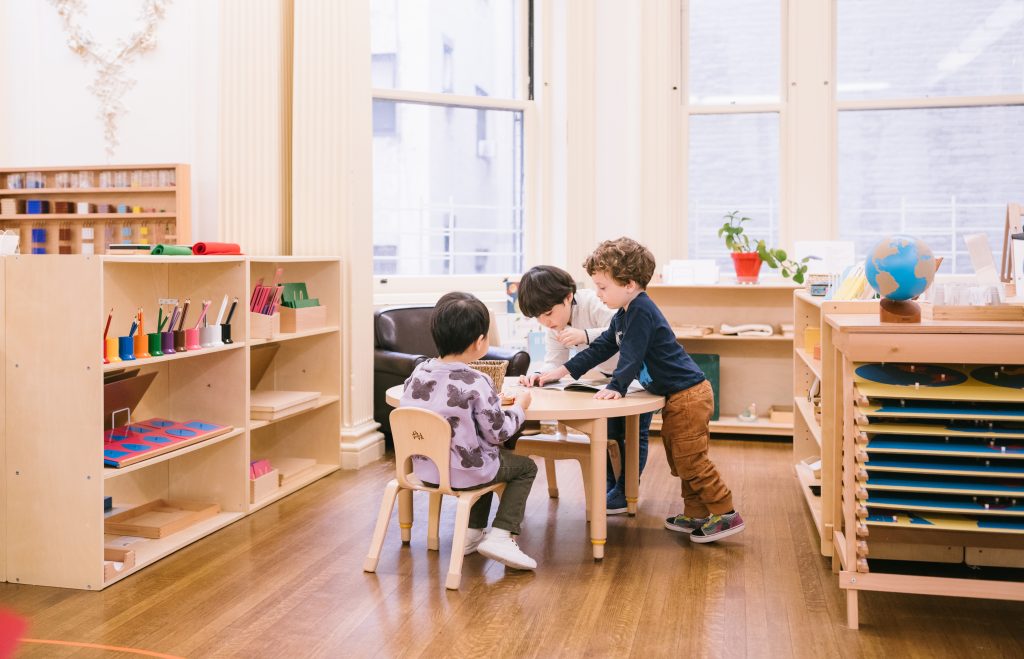
How to Use Positive Discipline at Home
Positive Discipline works best when it feels lived, not performed.
These seven steps can help you guide your child through connection, clarity, and follow through. Each step reflects the heart of authoritative parenting, which is the combination of high warmth and high responsibility.
Remember, this is the style most closely aligned with Montessori principles and is the exact approach we use in our classrooms.
1. Stay calm and regulate yourself first
Your child cannot regulate if you are disregulated. Children borrow the adult’s nervous system. Your tone, posture, and breath set the emotional temperature of the room.
When you feel tension rising, pause, lower your voice, and ground your body before responding. This is the foundation of authoritative parenting.
Try simple scripts like:
- “Let’s take a breath together.”
- “I will wait until we both feel calm.”
Your calm presence signals safety, and safety is the starting point for cooperation.
2. Set clear limits and explain the “why”
Authoritative parents set firm boundaries with warmth. Limits protect your child’s safety and the harmony of your home. Children follow limits more readily when they understand the reason behind them.
Examples:
- “Inside we walk to keep people safe. You may jump outside.”
- “You can use the marker on paper or the whiteboard. These surfaces stay clean.”
Whenever possible, you can also offer choices to support autonomy:
- “Would you like to clean up with a cloth or a sponge?”
- “Do you want to open the door and check how cold it is outside? Do you think you’ll need a jacket?”
Clarity plus choice reduces power struggles and increases internal cooperation.
3. Use natural or logical consequences
Positive Discipline avoids punishments because punishment can trigger fear, shame, or rebellion. You might have heard yourself use phrases like these in the past:
- “We are never coming back here again!”
- “Fine, then no park for a week.”
- “If you don’t stop, you are going straight to your room.”
- “That’s it. All your toys are gone!”
These statements may stop the behavior temporarily, but they do not teach anything. They damage trust and usually escalate the power struggle.
Authoritative parents use natural or logical consequences instead. These consequences are directly connected to the behavior and teach responsibility without harming the relationship.
Examples:
- If a child spills water, they help wipe it up.
- If a material is damaged, the child helps repair it or waits until they can handle it responsibly.
- If a toy is thrown, the toy is put away because it is not being used safely.
- If a child refuses to put their plate away after dinner, it stays on the table until they are ready to do their part.
The goal is learning, not guilt. A meaningful consequence is fair, logical, and preserves the child’s dignity.
4. Involve the child in problem solving
Children want to contribute! Positive Discipline uses problem solving to build agency and accountability. Instead of lecturing or fixing everything for them, you invite them to think with you.
Try phrases like:
- “What can we try next time so this goes more smoothly?”
- “How can we fix this together?”
- “What would help your body feel calm right now?”
This approach teaches the child that mistakes are opportunities to learn, not moments of shame.
5. Create routines that support independence
Structure brings peace. Children thrive when the rhythm of the day is predictable and when they can do more things themselves.
Support independence with:
- A simple morning routine
- A tidy, accessible environment with child-sized tools
- Consistent rhythms for meals, snacks, and sleep
- A designated place for each belonging
When children know what comes next and have the tools to succeed, cooperation increases naturally.
6. Model respect and responsibility
Children absorb how we speak, move, and solve problems. Modeling is one of the strongest Positive Discipline strategies because children copy what we do, not what we say.
Examples:
- If you find a spill, say: “I will clean this up now,” instead of “Who made this mess?”
- When you’re personally overwhelmed, say: “I am feeling frustrated, so I will take a moment,” instead of reacting sharply.
The key here is to speak to your child with the same respect you would use with another adult.
The most important thing to remember is this: if you set a limit for your child, follow it yourself. For example, if you tell your child they cannot have candy before dinner, do not eat candy yourself in front of them or secretly in the kitchen. Consistency builds trust.
Your modeling becomes the blueprint your child uses when they face challenges, make decisions, and learn to regulate their emotions. And more importantly, figure out how to be good people.
7. Focus on encouragement, not praise
You might be thinking, “well, what’s the difference?”
Encouragement builds internal motivation.
Praise shifts a child’s focus toward pleasing others rather than valuing their own effort.
Praise sounds like:
- “Good job.”
- “You are so smart.”
- “You are such a good kid.”
Encouragement sounds like:
- “You worked hard to zip your coat.”
- “You kept trying, even when it was tricky.”
- “You noticed the spill and cleaned it up right away. That was helpful for us all, thank you.”
Positive Discipline places effort, growth, and capability at the center. When paired with encouragement, it strengthens all three and reinforces your child’s ability to find their calm and learn how to do hard things.
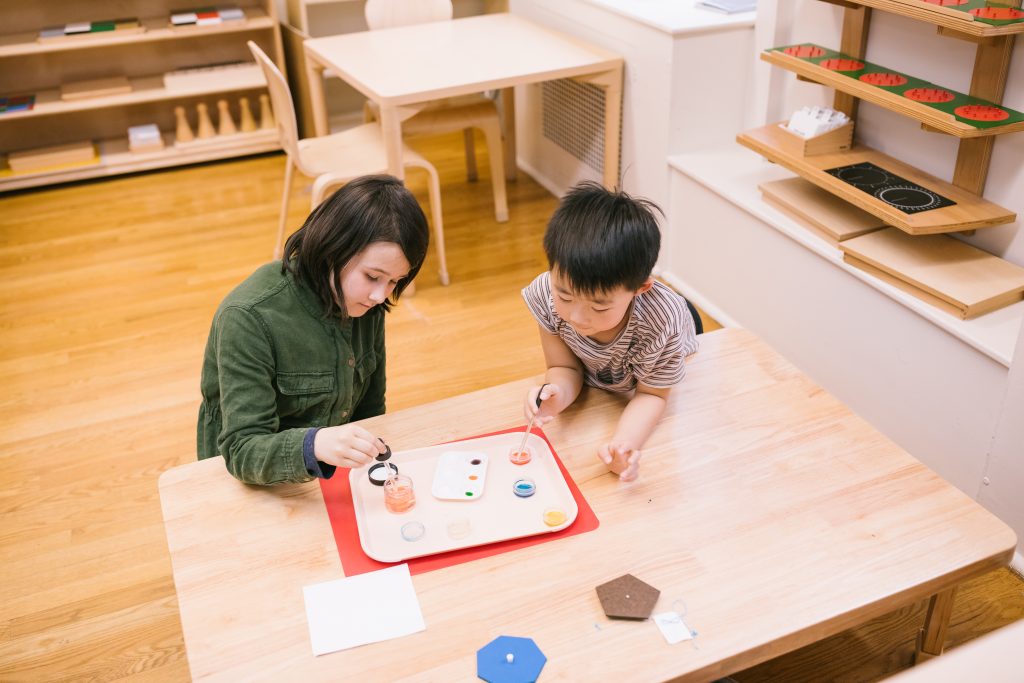
If You Want to Try Positive Discipline, but Your Family Is Not on the Same Page
This situation is extremely common. One parent often discovers Montessori, loves what they see in the classroom, enrolls their child, and then realizes they are not sure how to bring that same calm clarity into everyday home life, especially when it comes to discipline. (Cue the late-night ChatGPT search for “What is Montessori discipline?”)
You might find yourself trying things, feeling inconsistent, or wondering why certain strategies work for teachers but not for you.
The truth is that the same consistency children want is the very thing the immediate family must align on first.
If one parent leans permissive and another leans authoritarian, your child already knows the difference. Children are incredibly perceptive! They learn quickly and understand which adult allows what, who they can push, and where the limits bend. This creates confusion, mixed messages, and more power struggles, not fewer.
The first step is not jumping into techniques. The first step is having a simple, honest conversation and creating a united front. Your parenting styles do not need to be identical, but they do need to be moving in the same direction.
Using a framework like Positive Discipline and intentionally leaning toward the authoritative parenting style gives your family shared language, shared expectations, and shared follow through. Once you have that, the rest becomes much easier, and the calm you see in Montessori classrooms starts to take shape in your home too.
The Most Helpful Next Step
Watch Our Free Positive Phrasing Video
To help you get started, we want to make this as simple and accessible as possible. One of the easiest ways to align your immediate family is to learn from the same source.
To support you, we are excited to share one of the very first videos all of our teachers watch during their orientation week when they join Guidepost. And we are offering it to you for free!
This video breaks down the core principles of Positive Discipline in a clear, practical way, and it shows exactly how we use Positive Phrasing to guide children with high warmth and high responsibility.
It is the perfect starting point for families wanting to parent with more consistency, confidence, and calm.
If you enjoyed that video and want to explore the full course on Positive Phrasing, or browse other offerings, visit the Prepared Montessorian Institute’s course catalogue here.
A Final Reminder
Parenting is a learning journey. No one has it all figured out, and no one parents perfectly.
The fact that you are reading this resource already shows how much you care and how invested you are in giving your child the best possible foundation.
Every small effort you make today helps shape a childhood filled with safety, connection, and growth, and those experiences become the building blocks of a capable, confident adult.
You are doing meaningful work, and it matters more than you know.